Briar Rose is an indigenous storyteller and the Director of Storytelling at Farmer’s Footprint, where she leads narrative across film, editorial, and creative production.
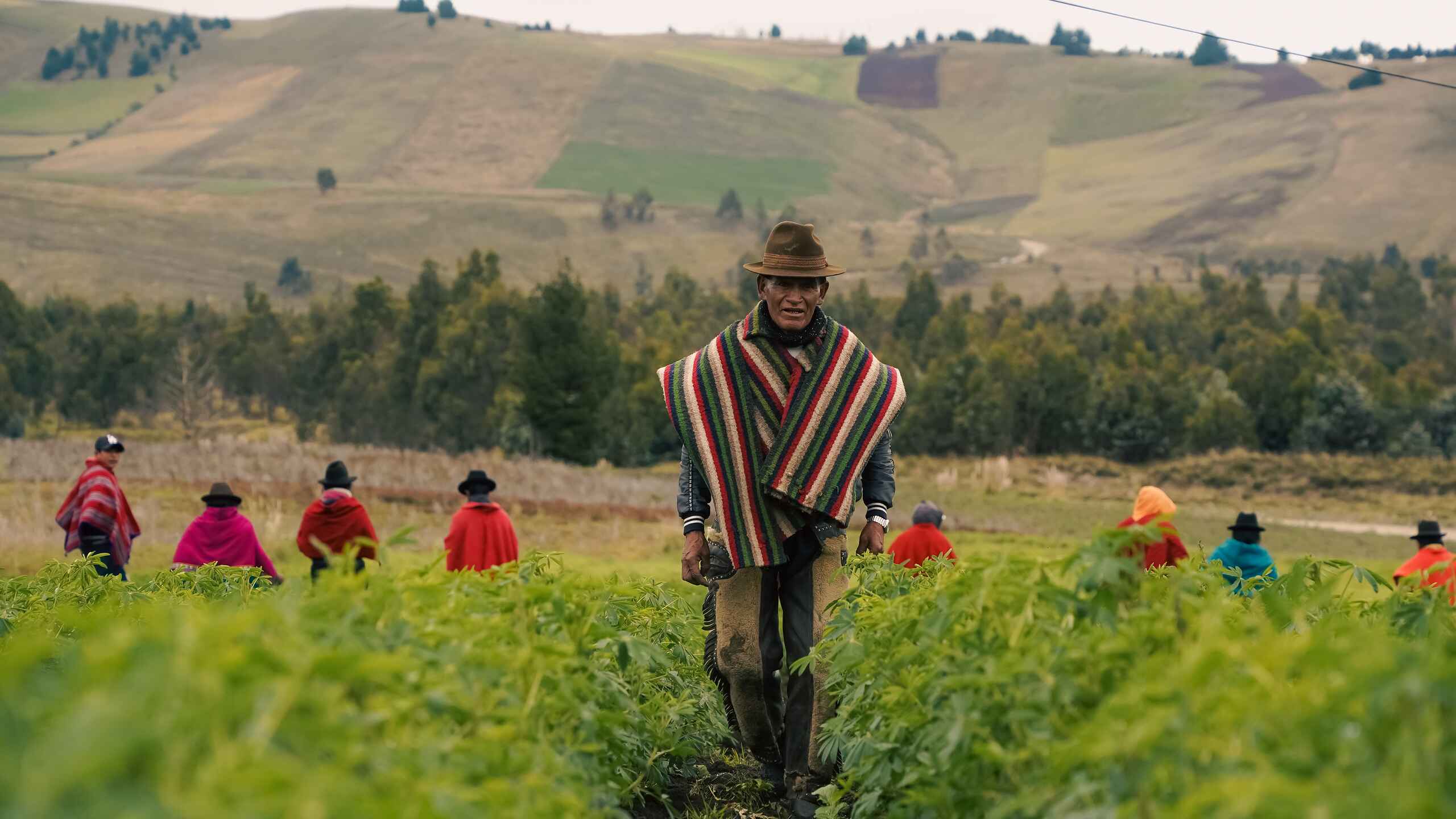
The Origins of Regenerative Agriculture in Indigenous and Traditional Knowledge
The principles behind regenerative agriculture didn't emerge in a lab. They trace directly to indigenous land stewardship practiced for thousands of years.
The ecological principles associated with regenerative agriculture are deeply rooted in Indigenous Knowledge Systems.
In recent years, regenerative agriculture has gained attention as an approach to farming that focuses on restoring soil health, biodiversity, and ecosystem resilience. While the term itself is relatively new, many of the principles associated with regenerative agriculture have long existed within Indigenous and traditional knowledge systems (FAO, 2021; Berkes, 2018). (For a deeper explanation of regenerative agriculture, see our article What Is Regenerative Agriculture?)
These systems developed through generations of close observation of local ecosystems, where farmers learned how soils, rainfall patterns, and plant varieties interacted within specific landscapes (Deb, 2009; Berkes, 2018).
Hopi dryland farmer and researcher Dr. Michael Kotutwa Johnson explains that Indigenous agricultural systems are shaped by the environment rather than controlling it.
. “Hopi crops are raised to fit the environment. The environment is not manipulated to fit the crops.”
This perspective reflects a foundational principle that many regenerative farmers are now rediscovering: sustainable food production depends on understanding the ecological conditions of a place and working within them. Indigenous agricultural knowledge developed these practices over centuries of experience, creating farming and food systems adapted to local climates, soils, biodiversity, and cultural responsibilities to the land (Deb, 2009).
For Indigenous communities, agriculture is not simply a set of techniques, but part of a broader relationship with the natural world, shaped by culture, community, and responsibilities to the land.
The origins of Indigenous agricultural knowledge
Across many cultures, agricultural knowledge emerged through close relationships with the landscapes people lived within. Farmers learned to observe the rhythms of their environments - how soils behave, when rainfall arrives, how plants grow in different conditions, and how ecosystems respond to seasonal change. Over time, these observations shaped ways of growing food that worked with local ecosystems rather than attempting to control them.
Rather than transforming landscapes to maximize production, many Indigenous agricultural systems adapted crops and farming practices to the conditions of a particular place. Seeds were selected for their ability to thrive in local soils and climates, while farming methods evolved through long-term observation of how plants, water, animals, and soil interact within an ecosystem.
Ecologist and seed conservationist Dr. Debal Deb describes this process as the long co-evolution between human communities and the environments they inhabit. Through generations of experimentation and observation, farmers developed agricultural systems deeply adapted to specific ecological conditions (Deb, 2009). These knowledge systems reflect an understanding that agriculture is not separate from nature, but part of a living system where soil, water, plants, animals, and people exist in relationship.
These long-standing relationships between people, land, and ecosystems have shaped agricultural practices across Indigenous cultures for generations. Many of the ecological principles now associated with regenerative agriculture reflect these same relationships with land and ecology.
Regenerative agriculture inspired by Indigenous Knowledge Systems (IKS)
Many of the ecological principles now associated with regenerative agriculture are deeply rooted in indigenous knowledge systems and draw inspiration from relationships with land that Indigenous communities have practiced through their food systems for generations (Berkes, 2018; FAO, 2021).
Across cultures, Indigenous farmers developed ways of growing food that worked in harmony with their surrounding environments. These principles honor soil as a living system, biodiversity within agricultural landscapes, and agricultural practices guided by seasonal cycles and ecological conditions.
Land stewardship is not only about producing food, but about sustaining the ecosystems that support life. Within Indigenous worldviews, human wellbeing is inseparable from the health of our planet, and rather than dominating landscapes, these agricultural systems are anchored in learning from and working with nature.
In recent years, regenerative agriculture has gained attention for approaches such as rebuilding soil health, increasing biodiversity, and working with natural ecosystem processes. While these practices are often framed through scientific research and modern land management frameworks, many of the underlying ecological ideas are deeply rooted in knowledge systems that Indigenous communities have long practiced through place-based food systems (Berkes, 2018; IPBES, 2019).
As Dr. Michael Kotutwa Johnson explains, Indigenous agricultural systems developed through long relationships between communities and the environments they inhabit:
“Indigenous agriculture developed in relationship with the land over thousands of years. Modern agriculture has much to learn from these systems, especially the understanding that farming must adapt to the environment rather than forcing the environment to adapt to farming.”
Indigenous Ecological Principles Reflected in Regenerative Agriculture
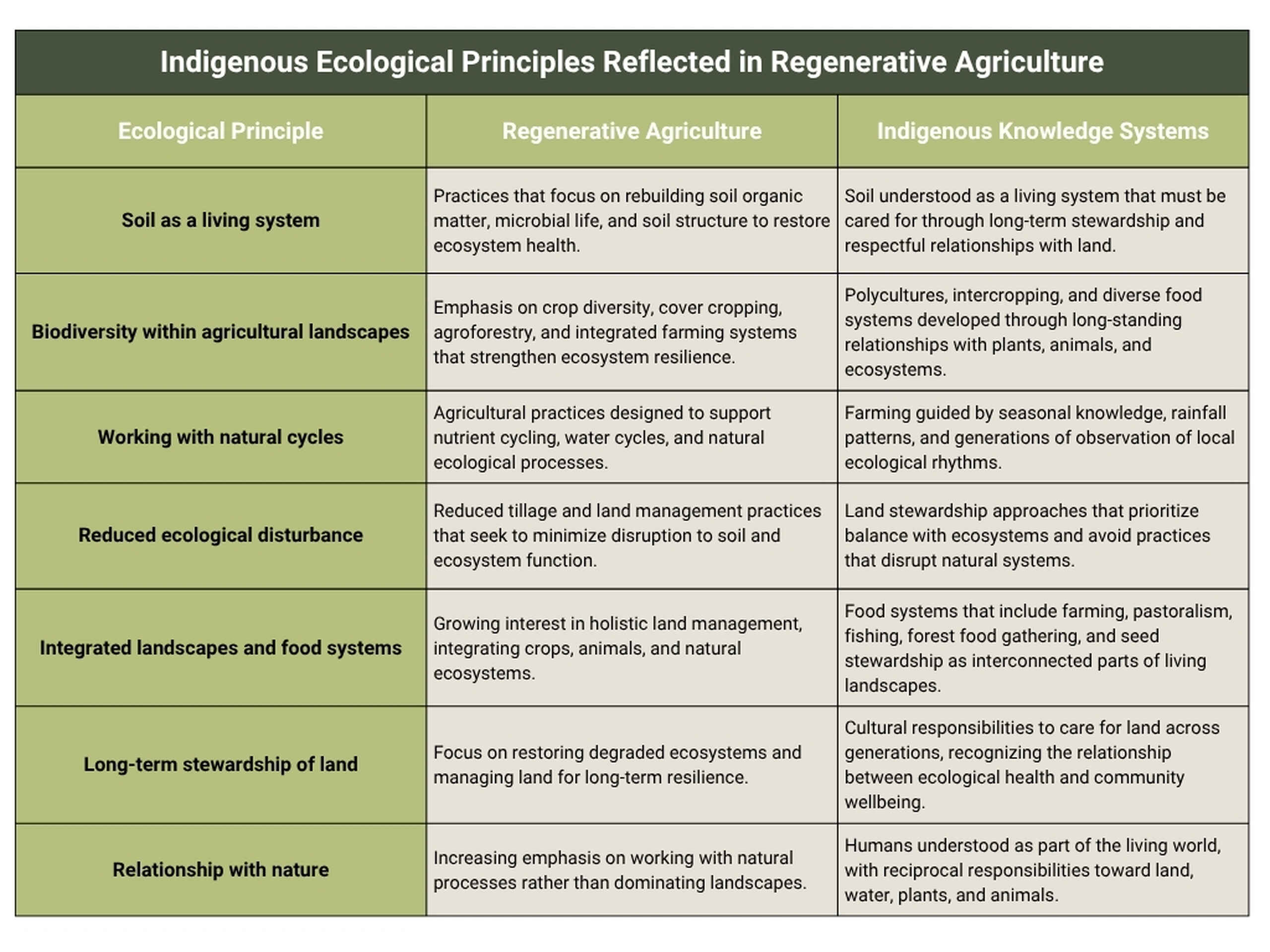
These ecological principles have long been documented within Indigenous agricultural knowledge systems and traditional food systems. Contemporary research in agroecology and environmental science increasingly recognizes the importance of Indigenous knowledge for sustaining biodiversity, strengthening ecosystem resilience, and informing sustainable land stewardship (Berkes, 2018; FAO, 2021; IPBES, 2019; Deb, 2009).
This acknowledgement helps us to understand that regenerative agriculture can be seen as rediscovering ecological principles that have long existed within Indigenous agricultural knowledge systems.
Further, Indigenous food systems extend beyond farming practices alone. They honor broader cultural relationships that connect land stewardship with community responsibility, cultural teachings, and spiritual relationships with the natural world.
Honoring the culture in agriculture
Within Indigenous societies, agriculture is deeply rooted in culture. Food production is connected to language, ceremony, seasonal traditions, and communal wisdom about how to live in right relation with the land. As Māori researcher Dr. Jessica Hutchings explains, Indigenous food systems are not simply methods of producing food but cultural systems that connect people, land, knowledge, and community across generations.
Agricultural knowledge is carried through cultural practices such as ceremony, seasonal gathering, language, and storytelling. These traditions guide how food is grown, harvested, and shared, while reinforcing the responsibilities people hold toward the ecosystems that sustain them. In this perspective, agriculture becomes not only a method of producing food, but a cultural expression of how communities live in relationship with land.
Robin Wall Kimmerer, botanist and member of the Citizen Potawatomi Nation, similarly describes how Indigenous cultures understand humans as part of the living world:
“In traditional Indigenous worldviews, humans are not separate from the natural world. We are members of the community of life, and our cultures carry the responsibility to care for the land that sustains us.”
Research increasingly recognizes that Indigenous food systems are deeply rooted in cultural knowledge and social relationships that guide how ecosystems are cared for and how food is grown, harvested, and shared (FAO, 2021).
As Hopi dryland farmer and researcher Dr. Michael Kotutwa Johnson explains:
“For Indigenous people, agriculture is not only about growing food. It is part of culture, part of identity, and part of our responsibility to the land.”
These cultural dimensions explain why Indigenous agricultural and food systems are understood to be more than farming techniques, they represent living knowledge systems shaped by relationships between people, land, food, and community.
Understanding this broader context also helps explain why Indigenous agricultural systems are deeply shaped by the places where they developed.
Indigenous agriculture and the importance of place
An important distinction that Dr. Michael Kotutwa Johnson often highlights is that many modern regenerative farming frameworks attempt to replicate a set of practices across different landscapes. In contrast, Indigenous agricultural systems have always been deeply place-based. Farming practices emerged from the unique ecological conditions, cultural traditions, and spiritual relationships connected to specific lands (Johnson, 2021, Berkes, 2018).
“Indigenous agriculture is not a set of techniques. It is a relationship with the land.”
This perspective shows why Indigenous agricultural systems often differ from modern regenerative agriculture frameworks. While regenerative agriculture typically focuses on restoring ecosystems through improved land management practices (Savory, 2013), Indigenous food systems are developed through long-standing relationships between communities and the environments they inhabit.
Over generations, Indigenous farmers adapted crops, seeds, and farming practices to the particular soils, climates, and ecosystems of their regions. Rather than applying universal techniques, Indigenous food systems approach land stewardship as an ongoing relationship, where knowledge is carried through culture, memory, and lived experience.
IKS, TEK & Regenerative Agriculture
As conversations around regenerative agriculture continue to grow, it is important to recognize that many of the ecological principles guiding these practices emerge from Indigenous Knowledge Systems (IKS) and Traditional Ecological Knowledge (TEK), developed over generations through close relationships with land, culture, and place.
Within these knowledge systems, agriculture is part of a broader way of living that understands humans as participants within living systems, with responsibilities to care for the ecosystems that sustain life.
Seen through this lens, regeneration becomes something deeper than a set of farming practices; it is a continuation of knowledge that has existed for millennia. Regenerative agriculture, at its core, is rooted in Indigenous and traditional ways of knowing - in observation, reciprocity, and place-based relationship.
To acknowledge this is not only to honor the wisdom holders of these systems, but to understand that true regeneration cannot be separated from the knowledge systems, cultures, and communities that have carried these practices forward.
Regenerative agriculture, therefore, is not a new model, it is rooted in Indigenous and traditional knowledge systems, and it is the remembering of how to live within the systems that sustain life.
Sources:
Berkes, F. (2018). Sacred ecology (4th ed.). Routledge.
Deb, D. (2009). Beyond developmentality: Constructing inclusive freedom and sustainability. Earthscan.
Food and Agriculture Organization of the United Nations (FAO). (2021). Indigenous peoples’ food systems: Insights on sustainability and resilience from the front line of climate change. FAO.
Hutchings, J. (2015). Te mahi māra hua parakore: A Māori food sovereignty handbook. Papawhakaritorito Charitable Trust.
Intergovernmental Science-Policy Platform on Biodiversity and Ecosystem Services (IPBES). (2019). Global assessment report on biodiversity and ecosystem services. IPBES Secretariat.
Johnson, M. K. (2021). Enhancing integration of Indigenous agricultural knowledge into conservation practices. Journal of Soil and Water Conservation. https://www.tandfonline.com/doi/abs/10.2489/jswc.2021.00179
Kimmerer, R. W. (2013). Braiding sweetgrass: Indigenous wisdom, scientific knowledge and the teachings of plants. Milkweed Editions.
Savory, A. (2013). Holistic management: A commonsense revolution to restore our environment (3rd ed.). Island Press.
More Education Articles





Support our work
Stay Connected
You’ll receive our monthly Field Notes newsletter, project updates, and free resources, plus you’ll get first access to new stories.

Make a Donation
Your tax-deductible gift fuels the storytelling that shifts culture, the organizing that turns awareness into collective action, and the relationships that make long-term systems change possible.